Highlights of the 4th Japan-Bangladesh Research and Practice Conference 2025

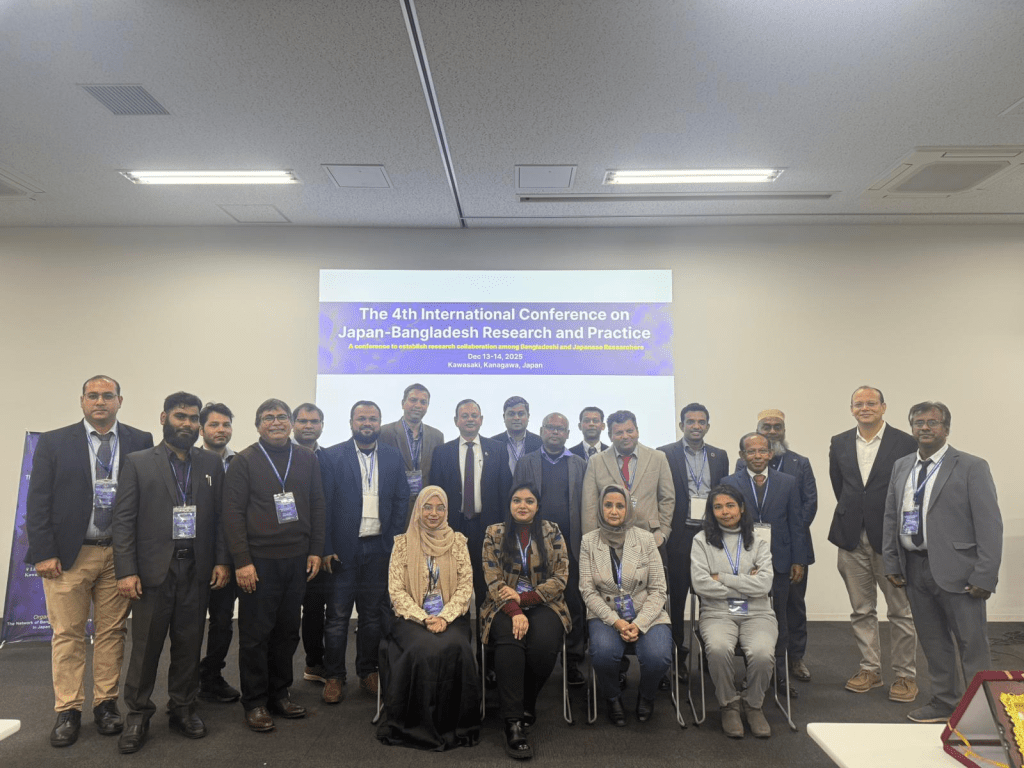
The 4th International Conference on Japan–Bangladesh Research and Practice (JBRP 2025), organized by the Network of Bangladeshi Researchers in Japan (NBRJ), was successfully held on December 13–14, 2025, in Kawasaki City—one of the major cities in the Greater Tokyo Area and a core part of Japan’s Keihin Industrial Zone.

This flagship event of Network of Bangladeshi Researchers in Japan (NBRJ) served as a platform for knowledge exchange and the presentation of innovative research addressing shared challenges and opportunities across multiple disciplines, with special emphasis on Japan–Bangladesh scientific collaboration and development. The conference proceedings is downloadable from here: https://www.dropbox.com/scl/fi/w03jnnmrg6uv0r3grv4pf/Final-JBRP2025-Proceedings_20251213_V7.pdf?rlkey=4mbe5j9ske06rzm3bvzz0crcd&e=1&st=0uhan670&dl=0

The JBRP 2025 Organizing Committee worked diligently over several months to create an outstanding multidisciplinary program featuring 45 abstracts presented in nine sessions across three thematic tracks:1) Natural and Agricultural Sciences, 2) Medicine, Pharmaceutical, and Public Health, and 3) Business, Humanities, and Social Sciences.  The conference featured world-renowned speakers, including one keynote, one special keynote, and six distinguished plenary speakers:

  • Professor Ken Motokura, Graduate School of Engineering, Yokohama National University
  • Professor Tetsushi Sonobe, National Graduate Institute for Policy Studies (GRIPS)
  • Professor Md. Amzad Hossain, Graduate School of Agriculture, University of the Ryukyus
  • Professor Sahoko Ichihara, Jichi Medical University
  • Dr. Khalid M. Khan, Sam Houston State University
  • Professor Takashi Saito, Health Sciences University of Hokkaido
  • Professor Shoab Bhuiyan, Suzuka University of Medical Science

The conference presented world-class research, covering a broad range of contemporary topics in science, technology, and innovation. It offered participants valuable opportunities for in-depth discussion and academic exchange. Best Presentation Awards were presented to three emerging researchers—Dr. Md. Nabiul Islam (Yamaguchi University), Dr. Md. Mustafizur Rahman (Jahangirnagar University), and Dr. Forhad Hossain (Sophia University)—in recognition of their outstanding contributions.

Most of the presenters were Bangladeshi and Japanese researchers and graduate students working in Japan, Bangladesh, and other countries. Their participation showcased how scholars from both nations are advancing global knowledge and innovation. The event reaffirmed the shared commitment of Bangladesh and Japan to contributing to the global community through research, science, and education.

NBRJ extends heartfelt gratitude to its Board Members—especially Dr. Khandakar Mizanur Rahman, President of NBRJ, and Dr. Sharif Ura, Representative Director—for their unwavering support throughout the conference, as well as to the track advisors:

  • Natural and Agricultural Sciences: Dr. Md. Amzad Hossain, Dr. S. M. A. Hakim Siddiki,Dr. Tofael Ahmed, Dr. Anisur Rahman Jamil
  • Medicine, Pharmaceutical, and Public Health: Dr. Md. Riasat Hasan, Dr. Shafiur Rahman, Dr. Md. Shiblur Rahman, Dr. Tazbir Ahmed
  • Business, Humanities, and Social Sciences: Dr. Khandakar Mizanur Rahman, Dr. Mohammad Abdul Malek, Dr. Jahangir Alam, Dr. Ranjan Saha Partha

NBRJ also acknowledges the dedicated efforts of:

  • Dr. Mohammad Abdul Malek (General Chair)
  • Dr. S. M. A. Hakim Siddiki (Technical Committee Co-Chair)
  • Dr. Shafiur Rahman (Technical Committee Co-Chair)
  • Dr. Md. Shiblur Rahman (Organizing Committee Co-Chair)
  • Dr. Anisur Rahman Jamil (Organizing Committee Co-Chair)

Special thanks are extended to Mr. Md. Daud Ali, His Excellency the Ambassador of Bangladesh to Japan, and Dr. Eiji Yamada, Senior Deputy Director at JICA, for their valuable contributions to the concluding panel discussion titled “Deciphering the Bangladesh Development Miracle.”

The 4th NBRJ-JBRP 2025 Conference was also supported by KCF Co. Ltd (www.kcfjp.com) and Biggani.org. 

JBRP 2025

We are happy to announce that the 4th Japan-Bangladesh Research and Practice (JBRP) will be held at Kawasaki, Kanagawa, Japan, from 13-14 December. We expect many researchers to gather together and share their ideas and experiences. You are most welcome to submit an abstract of your work and present your work at the conference. Please check the conference site for the details.

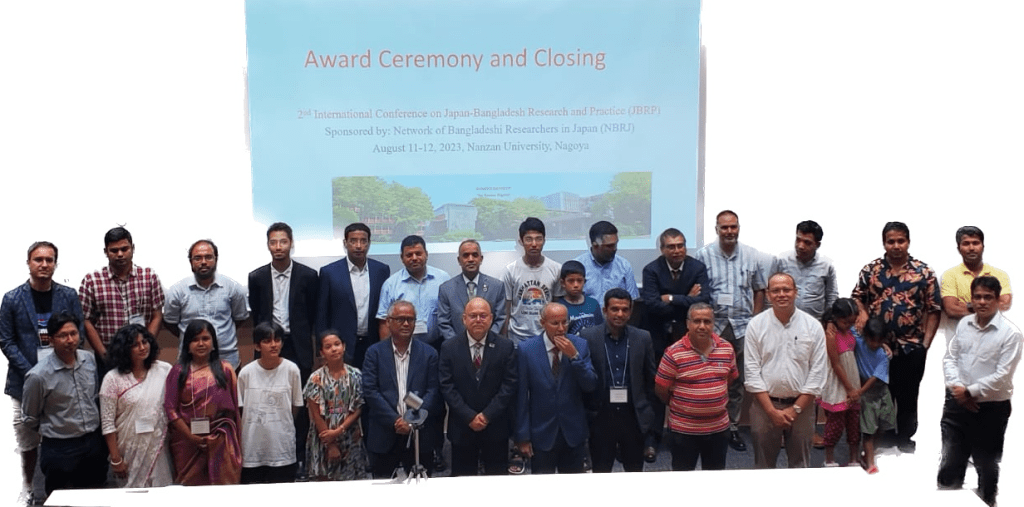
NBRJ-JBRP 2023 Ended at Nagoya, Japan

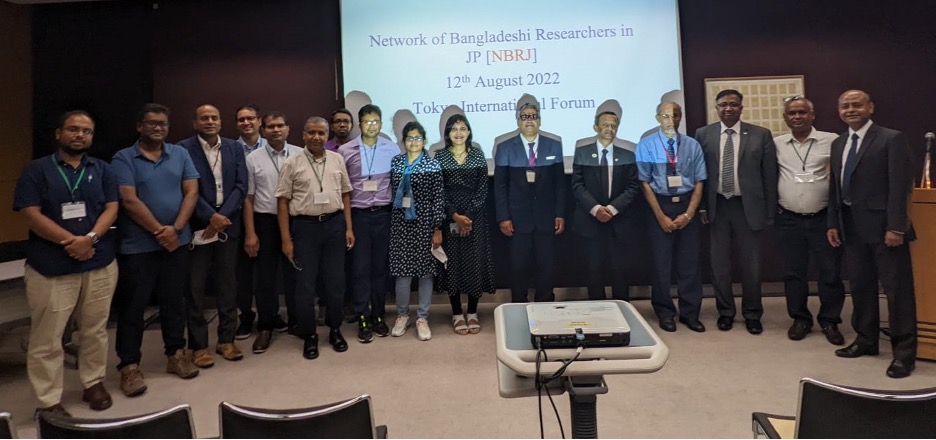
 It is worth mentioning that JBRP is a flagship event organized by the Network of Bangladesh Researchers in Japan (NBRJ, https://atomic-temporary-193405763.wpcomstaging.com). The NBRJ was formally established on August 12, 2022, through a general meeting held at the Tokyo International Forum at its first annual workshop inaugurated by H.E. Mr. Shahabuddin Ahmed, Ambassador of Bangladesh in Japan in Tokyo. NBRJ aims to bring together Bangladeshi (origin) researchers working at different universities, research organizations, industries, and corporate sectors across Japan. The conference continues last year’s workshop (https://nbrjdotjp.wordpress.com/workshop2022/) with a new name and look. JBRP provides a platform for researchers across different scientific fields to share their achievements for creating multidisciplinary research collaboration opportunities and learning from each other, and make a bridge to achieve NBRJ’s vision to be the leading research and policy advocacy group in Japan with interdisciplinary skills dedicated to inform and leverage the development of Bangladesh through promoting Japan-Bangladesh scientific and development cooperation, intellectual engagement, and policy advocacy. 

The keynote titled “Uncovering Knowledge” was delivered by Professor Sharifu Ura, Kitami Institute of Technology, Hokkaido who leads KIT’s Advanced Manufacturing Engineering Lab and directs the Innovative Manufacturing Center for Education and Research. In the talk, the speaker uncovers knowledge, presents an epistemology-based scheme of eliciting knowledge in simple terms, and shows that knowledge becomes more meaningful when different forms of knowledge are integrated into a knowledge map and co-creation through transdisciplinary problem-solving activities by researchers and practitioners. 

 In the tutorial session titled `From Data to Knowledge; how machine learning (ML) technologies may help in your discipline`, the speakers had a comprehensive discussion and useful tips about ML techniques across the disciplines with applications. The applications discussed in the tutorial include digital health care, sensors and system design, and evidence-based Social Science Research. The panel of speakers include Dr. Md Shoaib Bhuiyan, Suzuka University of Medical Science, Dr. Ashir Ahmed, Kyushu University and SocialTech Japan, Dr. Mahfuzul Islam, Kyoto University, and Dr. Mohammad Abdul Malek, University of Tsukuba. The tutorial session was organized by Dr. Md Shoaib Bhuiyan, a Professor at the Suzuka University of Medical Science’s Health Data Science Department and in its Graduate School of Medical Science.

On the second day, at the end of all technical sessions but before the award and closing event, a panel discussion was organized to provide a platform for the researchers to learn how their excellent research outcome can be applied to solve various social problems and policymaking for Bangladesh.  The topic of the discussion was “Collaboration between Bangladeshi researchers and practitioners for JICA’s Projects/Programs in Bangladesh”.  After having a background presentation on JICA projects and program operations in Bangladesh by Mr. Syed Nasir Ershad, the Economic Minister, The Embassy of Bangladesh in Tokyo, four panelists, namely, Dr. Chowdhury Mahbubul Alam, Fukuoka Women’s University, Dr. Tofael Ahamed, University of Tsukuba, Dr.  Salma Akter, Kyoto University, and Dr.  Shoaib Bhuiyan, Suzuka University of Medical Science shed their reflections about how the collaborations between researchers and practitioners across the sectors (public, private, and NGOs) can better contribute across the domains to create an ‘evidence base’ for qualitative improvements of future projects and programs in Bangladesh. The major suggestion that came up in the discussion includes creating a joint fund for developing human capital and accelerating innovation where NBRJ researchers can better contribute to the path of ongoing Bangladesh development journey from a lower middle-income country to an upper middle-income country by 2031, and an advanced country by 2041. The Panel discussion was organized and moderated by Dr. Mohammad Abdul Malek, Associate Professor of Development Economics and South/Southeast Asian Studies at the University of Tsukuba, and the founding Coordinator for NBRJ.

 This year, the committee received 41 abstracts from universities and research institutes in Japan and Bangladesh representing cutting-edge results from different research fields. In the end, 26 presentations were presented in a two-day program, and several presentations were nominated for awards based on the votes from the conference committee members and session chairs. While the best presentation and special presentation went, respectively to Dr. Sadequl Islam, Nagoya City University, and Dr. Shofiqur Rahman, Immunology Research Institute in Gifu, the young presentation awards went to Kazi Faiz Alam, University of Tsukuba, Raul R. Rodriguez, Kyoto University, and Forhad Hossain, Kyushu University. 

The NBRJ-JBRP 2023 committee members included Dr. Khandakar Mizanur Rahman, Nanzan University as General Chair, Dr. Mohammad Abdul Malek, University of Tsukuba and Dr. Mahfuzul Islam, Kyoto University respectively as Technical Program Co-Chairs, Dr. Mehadi Aman, Sharp Corporation, Dr. Shamim Jubair Ahmed, The University of Tokyo and Dr.  Tania Afroj, Kobe University, respectively as Organizing Committee Co-Chairs, and Dr. Saad Khan, Santec Corporation as Local Arrangement Chair. The two-day conference sponsored by NBRJ, and also supported by Nanzan University, gets a good success which is the outcome of the hard work and efforts of the authors, reviewers, committee members, and session organizers/chairs.  

 It was also announced that the NBRJ-JBRP 2024 will be organized at the University of the Ryukyus, located in Okinawa, the southernmost prefecture of Japan, and Professor Md. Amzad Hossain will act as General Chair for the next conference. 

Network of Bangladeshi Researchers in Japan (NBRJ) formally kicked off in Tokyo

The formal letter from the committee coordinator Professor Malek is here.

A network of Bangladeshi (origin) Researchers in Japan (NBRJ), with about 60 members of faculties and researchers of Bangladeshi (origin) working in Japanese universities, research institutes, and industries, was formally kicked off by its first in-person flagship annual event, multidisciplinary research workshop at 50 years of Bangladesh, in Tokyo International Forum, Tokyo on 12 August 2022. The network was initiated earlier by a zoom-based network meeting on 12 March 2021 during the Covid 19 pandemic.

The NBRJ sets a vision to be known as the leading research and policy advocacy group in Japan with interdisciplinary research skills dedicated to informing and leveraging the development of Bangladesh through promoting Japan-Bangladesh scientific and development cooperation, intellectual engagement, and policy advocacy. We gradually envision symbiosis (共生) and coexistence (共存) with Japanese researchers and research bodies that have similar interests and goals.

At its annual event, the general meeting with about 30 members is organized, and a working committee is formed and planned to formulate its bylaws, complete society registration, and like. It is also planned that the second annual flagship workshop will be held in August 2023 at Nanzan University, Nagoya, to be chaired by Professor Khondakar Mizanur Rahman.

In its first multidisciplinary workshop, about 18 papers on Bangladesh issues were presented in four major disciplines, namely 1) Business, Humanities, and Social Science, 2) Agricultural Science, 3) Medical, Pharmaceuticals, and Public Health, and 4) Natural Sciences, Engineering, and ICT. In addition, a workshop proceeding compiling all abstracts is published, and a book with extended abstracts has been planned for wider circulation and dissemination. Professor Sharifu Ura at Kitami Institute of Technology chaired the 2022 multidisciplinary research workshop.

The two days event was formally concluded by the Ambassador of Bangladesh to Japan, H.E. Mr. Sahabuddin Ahmed.  

New paper at Am J of Ag. Economics settle debate on system of rice intensification

The final paper on system of rice intensification (RCT with BRAC Bangladesh) finally got published in Am J of Agr Econ by Christopher B. Barrette (Connell University), Asad Islam (Monash University), Abdul Malek (University of Tsukuba), Deb Pakrashi Pakrashi (IIT, Kanpur) and Ummul Ruthbah (Monash University). Our results may help settle intense debates around SRI as a tool for boosting rice productivity and rice farmers’ well-being in the Global South.

For the paper, you may access here:

https://onlinelibrary.wiley.com/doi/10.1111/ajae.12245

A New Statistical Parameter Extraction Technique

A research group from Kyoto University led by Mahfuzul Islam developed a novel statistical parameter extraction technique that will help LSI (Large Scale Integration) circuit designers to accurately predict their chip performances.

Kensuke Murakami, Mahfuzul Islam, and Hidetoshi Onodera, “CDF Distance Based Statistical Parameter Extraction Using Nonlinear Delay Variation Models,” in 27th IEEE International Symposium on On-Line Testing and Robust System Design (IOLTS), June 2021.

Statistical parameter extraction is a technique to estimate the distributions of underlying physical parameters from a set of distributions of the observed parameters. For example, in the case of a MOS (Metal Oxide Semiconductor) transistor, the observable parameter is its drain current. However, the drain current of a MOS transistor is determined by many physical parameters such as the channel doping density, gate length, oxide thickness, work functions, and so on. The problem is that these parameters are statistical and thus the chip performance also becomes statistical. Estimation of chip’s performance, therefore, refer to estimating the distribution of the chip performance and calculating the worst-case value under certain probability. Thus, it is essential to have accurate statistical models of the physical parameters and simulate the circuit with the accurate models.

Estimation of the distributions of the physical parameters is challenging simply because we cannot measure them directly. We have to calculate their distributions from the distributions of the observable parameters, for example the current or frequency. State-of-the-art extraction techniques, that are often based on simple linear models, worked well under limited scenarios. These techniques also assume that the physical parameters follow normal distributions. However, with the advancement of CMOS technology, we encounter with new phenomena of noise and variation that the assumption of normal distribution does not hold anymore. As a result, there was a need for a new technique that can work with any distributions as well as with nonlinear models. This paper utilizes the concept of comparing two distributions using CDF (Cumulative Distribution Function) distance. We have defined a new CDF distance concept to help converge the extraction process quickly. The work is still ongoing. In the future, we expect the presented technique to be incorporated into the commercial simulation tools.