Author Archives: Mahfuz

Unknown's avatar

About Mahfuz

I am a free thinker who is working in academic.

Network of Bangladeshi Researchers in Japan (NBRJ) formally kicked off in Tokyo

The formal letter from the committee coordinator Professor Malek is here.
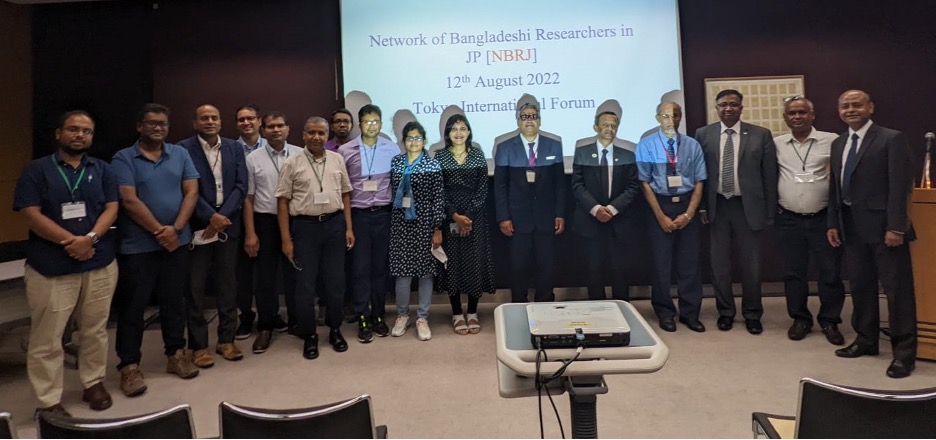
A network of Bangladeshi (origin) Researchers in Japan (NBRJ), with about 60 members of faculties and researchers of Bangladeshi (origin) working in Japanese universities, research institutes, and industries, was formally kicked off by its first in-person flagship annual event, multidisciplinary research workshop at 50 years of Bangladesh, in Tokyo International Forum, Tokyo on 12 August 2022. The network was initiated earlier by a zoom-based network meeting on 12 March 2021 during the Covid 19 pandemic.

The NBRJ sets a vision to be known as the leading research and policy advocacy group in Japan with interdisciplinary research skills dedicated to informing and leveraging the development of Bangladesh through promoting Japan-Bangladesh scientific and development cooperation, intellectual engagement, and policy advocacy. We gradually envision symbiosis (共生) and coexistence (共存) with Japanese researchers and research bodies that have similar interests and goals.

At its annual event, the general meeting with about 30 members is organized, and a working committee is formed and planned to formulate its bylaws, complete society registration, and like. It is also planned that the second annual flagship workshop will be held in August 2023 at Nanzan University, Nagoya, to be chaired by Professor Khondakar Mizanur Rahman.

In its first multidisciplinary workshop, about 18 papers on Bangladesh issues were presented in four major disciplines, namely 1) Business, Humanities, and Social Science, 2) Agricultural Science, 3) Medical, Pharmaceuticals, and Public Health, and 4) Natural Sciences, Engineering, and ICT. In addition, a workshop proceeding compiling all abstracts is published, and a book with extended abstracts has been planned for wider circulation and dissemination. Professor Sharifu Ura at Kitami Institute of Technology chaired the 2022 multidisciplinary research workshop.

The two days event was formally concluded by the Ambassador of Bangladesh to Japan, H.E. Mr. Sahabuddin Ahmed.  

A New Statistical Parameter Extraction Technique

A research group from Kyoto University led by Mahfuzul Islam developed a novel statistical parameter extraction technique that will help LSI (Large Scale Integration) circuit designers to accurately predict their chip performances.

Kensuke Murakami, Mahfuzul Islam, and Hidetoshi Onodera, “CDF Distance Based Statistical Parameter Extraction Using Nonlinear Delay Variation Models,” in 27th IEEE International Symposium on On-Line Testing and Robust System Design (IOLTS), June 2021.

Statistical parameter extraction is a technique to estimate the distributions of underlying physical parameters from a set of distributions of the observed parameters. For example, in the case of a MOS (Metal Oxide Semiconductor) transistor, the observable parameter is its drain current. However, the drain current of a MOS transistor is determined by many physical parameters such as the channel doping density, gate length, oxide thickness, work functions, and so on. The problem is that these parameters are statistical and thus the chip performance also becomes statistical. Estimation of chip’s performance, therefore, refer to estimating the distribution of the chip performance and calculating the worst-case value under certain probability. Thus, it is essential to have accurate statistical models of the physical parameters and simulate the circuit with the accurate models.

Estimation of the distributions of the physical parameters is challenging simply because we cannot measure them directly. We have to calculate their distributions from the distributions of the observable parameters, for example the current or frequency. State-of-the-art extraction techniques, that are often based on simple linear models, worked well under limited scenarios. These techniques also assume that the physical parameters follow normal distributions. However, with the advancement of CMOS technology, we encounter with new phenomena of noise and variation that the assumption of normal distribution does not hold anymore. As a result, there was a need for a new technique that can work with any distributions as well as with nonlinear models. This paper utilizes the concept of comparing two distributions using CDF (Cumulative Distribution Function) distance. We have defined a new CDF distance concept to help converge the extraction process quickly. The work is still ongoing. In the future, we expect the presented technique to be incorporated into the commercial simulation tools.

Review of the 1st NBRJ webinar

On the 3rd of April, NBRJ held its first webinar. Our first guest speaker was Dr. Nazmul Ahsan of the University of Tokyo. Dr. Nazmul is a Research Associate Professor, Department of New Energy, Research Center for Advanced Science and Technology, The University of Tokyo. In 2020, he was named ‘Fellow of the International Association of Advanced Materials (FIAAM, Sweden)’ to contribute to the “Advancement of Materials”. The title of his talk was “Breeding my research life – facing the dilemmas.” I had the privilege to moderate this talk. Dr. Nazmul touched on several vital points in his speech, especially for the young and early career researchers. I am giving some highlights of his address below. 

Dr. Nazmul emphasized the importance of being part of your professional network to succeed in an academic career. Often, you enter your professional network through your supervisor. Conversely, your supervisor will naturally try to increase his influence in the network by establishing his students as much as possible. Therefore, Dr. Nazmul suggested using your supervisor to your advantage in a good way. Make good relationships with your supervisor and earn his trust. Make a good team and try to learn to make effective communication with him. 

Dr. Nazmul then suggested having a mentor who can guide us throughout our careers. Therefore, you should choose a mentor as early as possible. Your mentor needs not be your supervisor or someone from your research field. Instead, it is better to have a mentor from outside of your research area. This way, your mentor can give you feedbacks objectively. 

Dr. Nazmul then focused on the importance of obtaining competitive research funds, such as the JSPS research grants, to establish himself as an independent researcher. We need to know the rules and guidelines beforehand and write the proposal according to the guidelines. A crucial point for a proposal is to illustrate your ideas using visuals rather than texts. 

One fantastic story we got to learn is that Dr. Nazmul once quit his Ph.D. There were many reasons behind his decision. Among them, the one reason that got my attention was he found it difficult to make sense of the data from his experiments. After spending some years in his own company, he came to realize the meaning of the data, and then he thought of giving it another shot. He came back to resume his Ph.D. and successfully earned his Ph.D. This story should encourage many Ph.D. students and early career researchers to persevere with his research. If necessary, one may take some time off, but we learned that perseverance could give you excellent results in the end. Dr. Nazmul also demonstrated his prowess in not only experiment design but also in theoretically evaluating different materials. As a result of his excellency, he could develop a solution for increasing the efficiency of solar cells much higher than the existing ones. 

As you can guess, the whole talk and the following Q&A session were so vibrant and exciting that we had to extend the original time slot. In the end, we had to end the session forcefully, although we could have continued as long as we could without any sign of fatigue in the audience. Such was the depth and weight of this speech. We were mesmerized. 

Finally, on behalf of the NBRJ, I would like to express our heartfelt gratitude to Dr. Nazmul for giving us an excellent and timely speech. We are looking forward to having Dr. Nazmul again in the future to hear his other stories. With this, I conclude this summary. I wish for the continuous development of NBRJ and all members. 

MAHFUZUL ISLAM
JUNIOR ASSOCIATE PROFESSOR
KYOTO UNIVERSITY

Investment Plight for Non-resident Bangladeshis (NRBs)

Remittances have undeniably a profound impact on the current economic progress of Bangladesh. Now, Bangladesh is no longer viewed as a bottomless basket but an emerging tiger in the Asian region. Considering the importance of remittances, the government of Bangladesh (GoB) has introduced various investment schemes such as Wage Earners Development Bond, US Dollar Premium Bond, and US Dollar Investment Bond for NRBs back in 1985 with the enactment of the Wage Earners Development Bond Rule, 1985. Some of the salient features of these investment securities were reinvesting the security after maturity, returning capital abroad, and providing CIP status to those who would invest Tk. 80 million. The GoB also introduced 2% cash incentives on the remittance amount to encourage remittances through the banking channel. These initiatives have undoubtedly motivated non-resident Bangladeshis (NRBs) to remit their hard-earned money in Bangladesh and become a partner of economic progress. However, a recent circular in December 2020 has lowered the investment limit in Wage Earners Development Bond, US Dollar Premium Bond, and US Dollar Investment Bond to Tk. 1 crore, in total, scrapped CIP status and ceased reinvestment facilities. Notably, NRBs who invest in the above securities do not receive the 2% cash incentives. Also, some positions such as professors and researchers working in a foreign university, government employees working in Bangladesh High Commissions and United Nations, and Bangladesh army deployed in UN peacekeeping missions do not receive any preferential treatment although they are considered as the most decent people who work hard to uphold the country image in abroad. More importantly, the situation of earnings and investing by Bangladeshi migrants, especially in Japan, Singapore, Malaysia, and some other Middle East countries, is different from that in other countries in the West. Migrant workers in the USA, Canada, Australia, and the UK seek citizenship and make their investments in fixed assets, in particular. However, double citizenship is not allowed in Japan, and we invest all our earnings in Bangladesh. Therefore, Bangladeshi citizens who uphold the country’s image holding an honorable position in Japan should be given special opportunities such as increasing investment limit, reinvestment of the matured securities, and repatriation of the original investment during emergencies. We believe that an encouraging policy on the investment for NRBs is needed considering the increased cost of living, social and economic security for the families of NRBs in Bangladesh, motivate NRBs by professions, and curb capital flights. Therefore, we urge the government to cease the present circular on the investment in Wage Earners Development Bond, US Dollar Premium Bond, and US Dollar Investment Bond. We have the following suggestions in this regard.   

  1. The investment made in wage earners bond and other securities prior to the circular on December 21, 2020, should be given reinvestment opportunities to prevent capital flights.  
  2. Some positions such as Professors and researchers working in a foreign university, government employees working in Bangladesh High Commission and United Nations, and Bangladesh army deployed in UN peacekeeping missions should be treated separately by increasing the investment limit and provide CIP status for them, as they work hard to uphold Bangladesh image in abroad.
  3. The combined investment limit for all the three securities, such as Wage Earners Development Bond, US Dollar Premium Bond, and US Dollar Investment Bond, may be limited to Tk. 8 crores to restore the previous CIP status. Furthermore, a particular scheme in investment can be introduced for NRBs serving in the honorable position in Japan, considering that Japan does not allow double citizenship, and there are many Bangladeshis who do not like to forgo Bangladesh citizenship.  
  4. Lower the interest rate on the above three investment securities and limit the investment made in Wage Earners Development Bond to Tk. 5 crores.