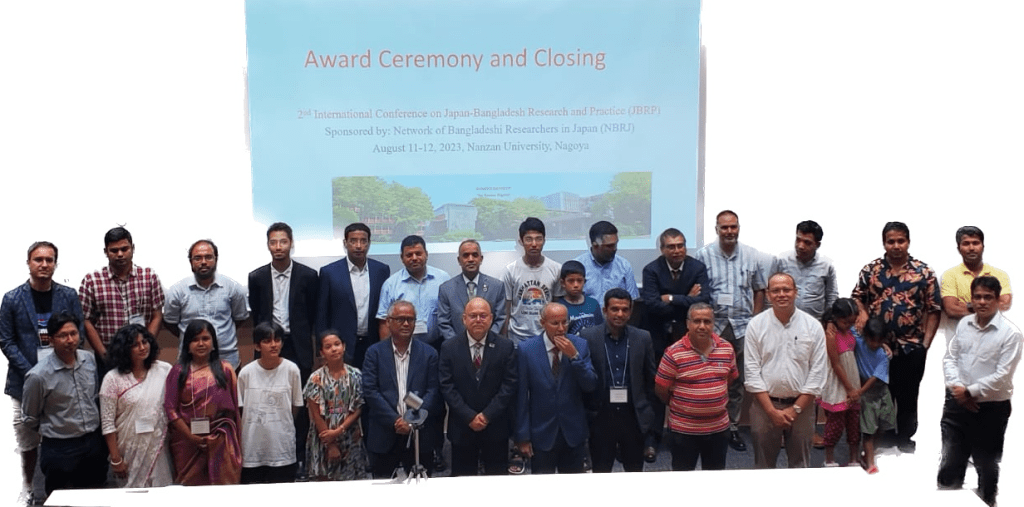
Sponsored by the Network of Bangladeshi Researchers in Japan (NBRJ), the 2nd International Conference on Japan-Bangladesh Research and Practice (JBRP) 2023 ended at August 12 2023 at Nanzan University located in the largest city in the Chubu region and the major industrial hub in Japan, at the outset of the great holiday (Obon festival) season. About 26 papers under 9 sessions were presented around four multidisciplinary domains (namely, 1. Business, Huminites, and Social Science, 2. Agricultural Science, 3. Medical, Pharmaceutical, and Public Health, 4. Natural Science, Engineering, and ICT) mostly from Bangladeshi (origin) researchers working in Japan. Apart from those sessions and the best presentation award, an insightful keynote, a tutorial session, and a panel discussion were also organized. Earlier, the conference was formally opened by Professor Kazumitsu Minamikawa, Dean of the Faculty of Business Administration, Nanzan University in August 11 morning 2023.
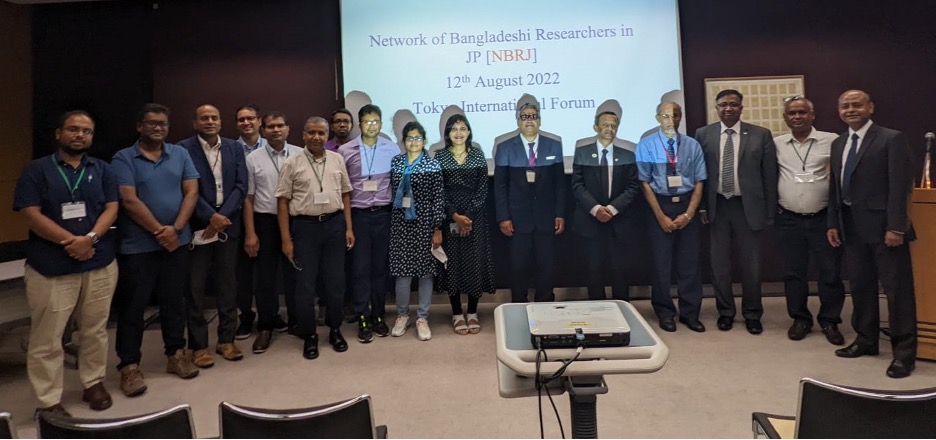
It is worth mentioning that JBRP is a flagship event organized by the Network of Bangladesh Researchers in Japan (NBRJ, https://atomic-temporary-193405763.wpcomstaging.com). The NBRJ was formally established on August 12, 2022, through a general meeting held at the Tokyo International Forum at its first annual workshop inaugurated by H.E. Mr. Shahabuddin Ahmed, Ambassador of Bangladesh in Japan in Tokyo. NBRJ aims to bring together Bangladeshi (origin) researchers working at different universities, research organizations, industries, and corporate sectors across Japan. The conference continues last year’s workshop (https://nbrjdotjp.wordpress.com/workshop2022/) with a new name and look. JBRP provides a platform for researchers across different scientific fields to share their achievements for creating multidisciplinary research collaboration opportunities and learning from each other, and make a bridge to achieve NBRJ’s vision to be the leading research and policy advocacy group in Japan with interdisciplinary skills dedicated to inform and leverage the development of Bangladesh through promoting Japan-Bangladesh scientific and development cooperation, intellectual engagement, and policy advocacy.
The keynote titled “Uncovering Knowledge” was delivered by Professor Sharifu Ura, Kitami Institute of Technology, Hokkaido who leads KIT’s Advanced Manufacturing Engineering Lab and directs the Innovative Manufacturing Center for Education and Research. In the talk, the speaker uncovers knowledge, presents an epistemology-based scheme of eliciting knowledge in simple terms, and shows that knowledge becomes more meaningful when different forms of knowledge are integrated into a knowledge map and co-creation through transdisciplinary problem-solving activities by researchers and practitioners.
In the tutorial session titled `From Data to Knowledge; how machine learning (ML) technologies may help in your discipline`, the speakers had a comprehensive discussion and useful tips about ML techniques across the disciplines with applications. The applications discussed in the tutorial include digital health care, sensors and system design, and evidence-based Social Science Research. The panel of speakers include Dr. Md Shoaib Bhuiyan, Suzuka University of Medical Science, Dr. Ashir Ahmed, Kyushu University and SocialTech Japan, Dr. Mahfuzul Islam, Kyoto University, and Dr. Mohammad Abdul Malek, University of Tsukuba. The tutorial session was organized by Dr. Md Shoaib Bhuiyan, a Professor at the Suzuka University of Medical Science’s Health Data Science Department and in its Graduate School of Medical Science.
On the second day, at the end of all technical sessions but before the award and closing event, a panel discussion was organized to provide a platform for the researchers to learn how their excellent research outcome can be applied to solve various social problems and policymaking for Bangladesh. The topic of the discussion was “Collaboration between Bangladeshi researchers and practitioners for JICA’s Projects/Programs in Bangladesh”. After having a background presentation on JICA projects and program operations in Bangladesh by Mr. Syed Nasir Ershad, the Economic Minister, The Embassy of Bangladesh in Tokyo, four panelists, namely, Dr. Chowdhury Mahbubul Alam, Fukuoka Women’s University, Dr. Tofael Ahamed, University of Tsukuba, Dr. Salma Akter, Kyoto University, and Dr. Shoaib Bhuiyan, Suzuka University of Medical Science shed their reflections about how the collaborations between researchers and practitioners across the sectors (public, private, and NGOs) can better contribute across the domains to create an ‘evidence base’ for qualitative improvements of future projects and programs in Bangladesh. The major suggestion that came up in the discussion includes creating a joint fund for developing human capital and accelerating innovation where NBRJ researchers can better contribute to the path of ongoing Bangladesh development journey from a lower middle-income country to an upper middle-income country by 2031, and an advanced country by 2041. The Panel discussion was organized and moderated by Dr. Mohammad Abdul Malek, Associate Professor of Development Economics and South/Southeast Asian Studies at the University of Tsukuba, and the founding Coordinator for NBRJ.
This year, the committee received 41 abstracts from universities and research institutes in Japan and Bangladesh representing cutting-edge results from different research fields. In the end, 26 presentations were presented in a two-day program, and several presentations were nominated for awards based on the votes from the conference committee members and session chairs. While the best presentation and special presentation went, respectively to Dr. Sadequl Islam, Nagoya City University, and Dr. Shofiqur Rahman, Immunology Research Institute in Gifu, the young presentation awards went to Kazi Faiz Alam, University of Tsukuba, Raul R. Rodriguez, Kyoto University, and Forhad Hossain, Kyushu University.
The NBRJ-JBRP 2023 committee members included Dr. Khandakar Mizanur Rahman, Nanzan University as General Chair, Dr. Mohammad Abdul Malek, University of Tsukuba and Dr. Mahfuzul Islam, Kyoto University respectively as Technical Program Co-Chairs, Dr. Mehadi Aman, Sharp Corporation, Dr. Shamim Jubair Ahmed, The University of Tokyo and Dr. Tania Afroj, Kobe University, respectively as Organizing Committee Co-Chairs, and Dr. Saad Khan, Santec Corporation as Local Arrangement Chair. The two-day conference sponsored by NBRJ, and also supported by Nanzan University, gets a good success which is the outcome of the hard work and efforts of the authors, reviewers, committee members, and session organizers/chairs.
It was also announced that the NBRJ-JBRP 2024 will be organized at the University of the Ryukyus, located in Okinawa, the southernmost prefecture of Japan, and Professor Md. Amzad Hossain will act as General Chair for the next conference.
 Network of Bangladeshi Researchers in Japan