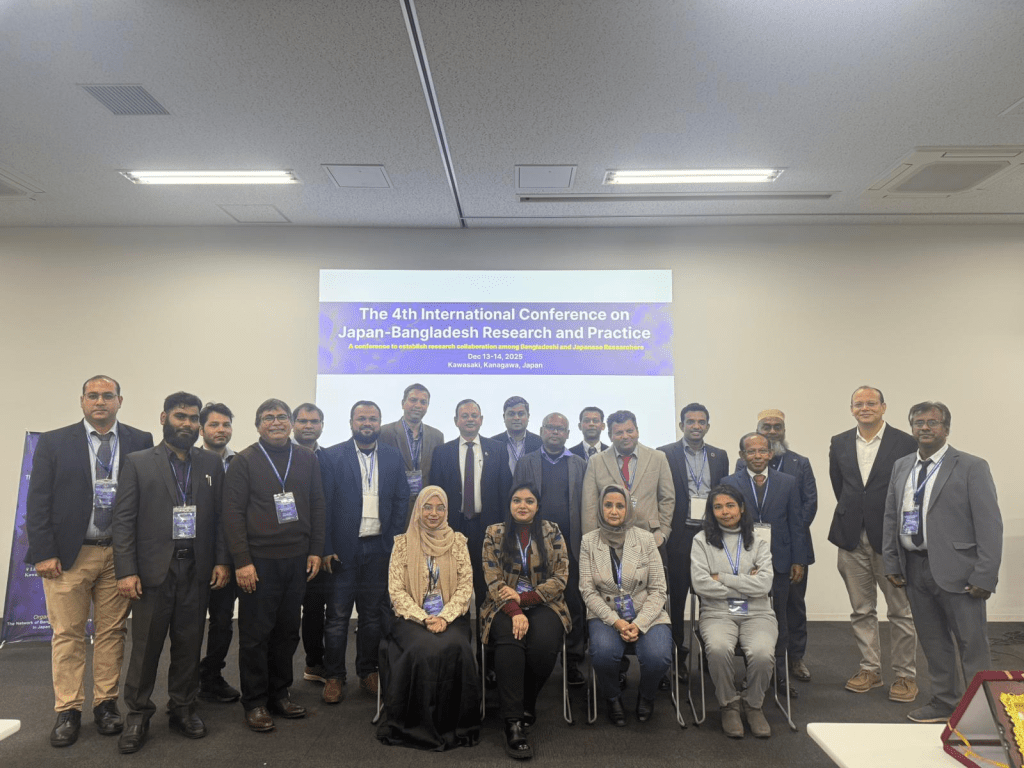
The 4th International Conference on Japan–Bangladesh Research and Practice (JBRP 2025), organized by the Network of Bangladeshi Researchers in Japan (NBRJ), was successfully held on December 13–14, 2025, in Kawasaki City—one of the major cities in the Greater Tokyo Area and a core part of Japan’s Keihin Industrial Zone.
This flagship event of Network of Bangladeshi Researchers in Japan (NBRJ) served as a platform for knowledge exchange and the presentation of innovative research addressing shared challenges and opportunities across multiple disciplines, with special emphasis on Japan–Bangladesh scientific collaboration and development. The conference proceedings is downloadable from here: https://www.dropbox.com/scl/fi/w03jnnmrg6uv0r3grv4pf/Final-JBRP2025-Proceedings_20251213_V7.pdf?rlkey=4mbe5j9ske06rzm3bvzz0crcd&e=1&st=0uhan670&dl=0
The JBRP 2025 Organizing Committee worked diligently over several months to create an outstanding multidisciplinary program featuring 45 abstracts presented in nine sessions across three thematic tracks:1) Natural and Agricultural Sciences, 2) Medicine, Pharmaceutical, and Public Health, and 3) Business, Humanities, and Social Sciences. The conference featured world-renowned speakers, including one keynote, one special keynote, and six distinguished plenary speakers:
- Professor Ken Motokura, Graduate School of Engineering, Yokohama National University
- Professor Tetsushi Sonobe, National Graduate Institute for Policy Studies (GRIPS)
- Professor Md. Amzad Hossain, Graduate School of Agriculture, University of the Ryukyus
- Professor Sahoko Ichihara, Jichi Medical University
- Dr. Khalid M. Khan, Sam Houston State University
- Professor Takashi Saito, Health Sciences University of Hokkaido
- Professor Shoab Bhuiyan, Suzuka University of Medical Science
The conference presented world-class research, covering a broad range of contemporary topics in science, technology, and innovation. It offered participants valuable opportunities for in-depth discussion and academic exchange. Best Presentation Awards were presented to three emerging researchers—Dr. Md. Nabiul Islam (Yamaguchi University), Dr. Md. Mustafizur Rahman (Jahangirnagar University), and Dr. Forhad Hossain (Sophia University)—in recognition of their outstanding contributions.
Most of the presenters were Bangladeshi and Japanese researchers and graduate students working in Japan, Bangladesh, and other countries. Their participation showcased how scholars from both nations are advancing global knowledge and innovation. The event reaffirmed the shared commitment of Bangladesh and Japan to contributing to the global community through research, science, and education.
NBRJ extends heartfelt gratitude to its Board Members—especially Dr. Khandakar Mizanur Rahman, President of NBRJ, and Dr. Sharif Ura, Representative Director—for their unwavering support throughout the conference, as well as to the track advisors:
- Natural and Agricultural Sciences: Dr. Md. Amzad Hossain, Dr. S. M. A. Hakim Siddiki,Dr. Tofael Ahmed, Dr. Anisur Rahman Jamil
- Medicine, Pharmaceutical, and Public Health: Dr. Md. Riasat Hasan, Dr. Shafiur Rahman, Dr. Md. Shiblur Rahman, Dr. Tazbir Ahmed
- Business, Humanities, and Social Sciences: Dr. Khandakar Mizanur Rahman, Dr. Mohammad Abdul Malek, Dr. Jahangir Alam, Dr. Ranjan Saha Partha
NBRJ also acknowledges the dedicated efforts of:
- Dr. Mohammad Abdul Malek (General Chair)
- Dr. S. M. A. Hakim Siddiki (Technical Committee Co-Chair)
- Dr. Shafiur Rahman (Technical Committee Co-Chair)
- Dr. Md. Shiblur Rahman (Organizing Committee Co-Chair)
- Dr. Anisur Rahman Jamil (Organizing Committee Co-Chair)
Special thanks are extended to Mr. Md. Daud Ali, His Excellency the Ambassador of Bangladesh to Japan, and Dr. Eiji Yamada, Senior Deputy Director at JICA, for their valuable contributions to the concluding panel discussion titled “Deciphering the Bangladesh Development Miracle.”
The 4th NBRJ-JBRP 2025 Conference was also supported by KCF Co. Ltd (www.kcfjp.com) and Biggani.org.


 Network of Bangladeshi Researchers in Japan